

June 17, 2026
About the Author: Stefan Joubert

Guitar playing becomes far more interesting when you begin to understand the difference between diatonic and chromatic notes.
This is why guitarists should understand diatonic and chromatic notes as these ideas help explain why certain notes feel natural, while others sound more colourful, tense or surprising.
These two musical ideas explain a great deal about melody, harmony, improvisation and expression.
Whether you play acoustic guitar, electric guitar, classical guitar, rock, pop, blues, jazz or metal, understanding them can make your playing more confident and more musical.
What Are Diatonic Notes?
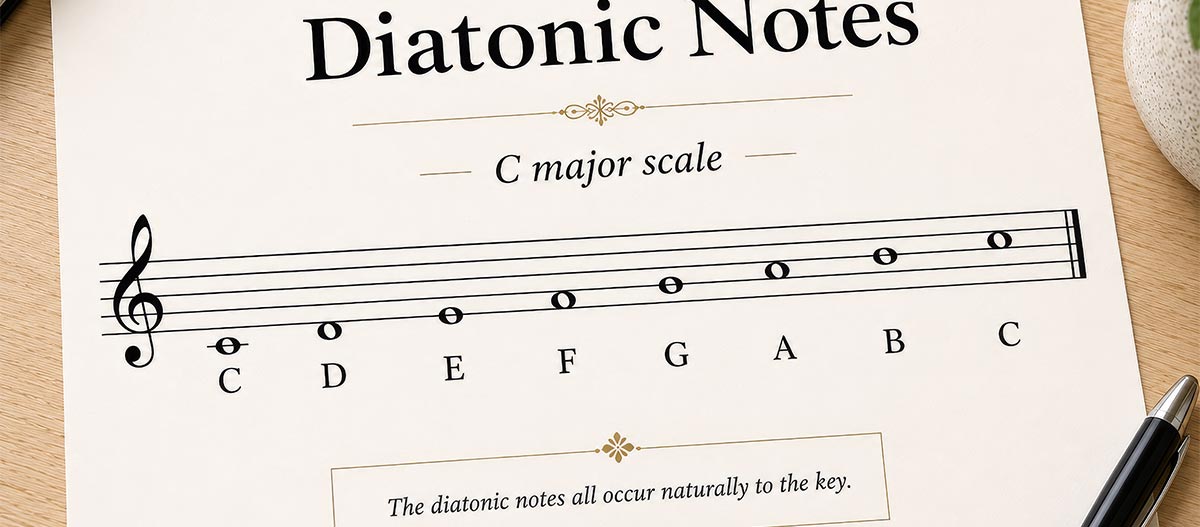
Diatonic notes are the notes that belong naturally to a particular key or scale.
For example, if you are playing in the key of C major, the diatonic notes are:
C, D, E, F, G, A and B.
These notes all belong to the C major scale.
When you use them, your melodies and chords tend to sound stable, clear and connected to the key.
On the guitar, diatonic notes are often the foundation of many familiar scale shapes and chord progressions.
They help you understand which notes fit comfortably within a song and why certain chords sound as though they belong together.
This is why diatonic playing is so important for beginners and developing guitarists.
It gives you a musical home base.
Once you know the notes that belong to a key, you can start to create melodies, riffs and solos that sound coherent rather than random.
What Are Chromatic Notes?
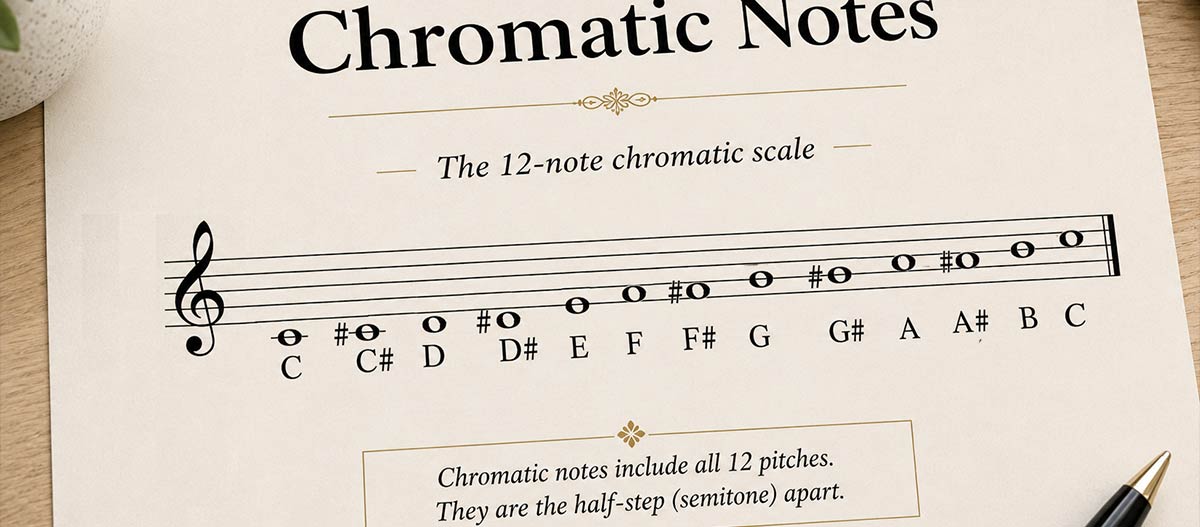
Chromatic notes are the notes outside the main key or scale.
They are the extra notes found between the diatonic notes.
On the guitar, chromatic notes are easy to see because each fret represents a semitone.
Moving one fret at a time up or down the neck creates chromatic movement.
For example, if you move from C to C sharp, then to D, then to D sharp, you are moving chromatically.
Chromatic notes can create tension, colour and movement.
They may sound unexpected at first, but when used well, they can make a phrase more expressive and sophisticated.
In many styles of guitar music, chromatic notes are used to approach a target note, connect scale positions, add bluesy tension, or make a solo sound more fluid.
They are especially common in blues, jazz, rock and fusion, but they appear in almost every style of music.
Why the Difference Matters
Understanding the difference between diatonic and chromatic notes helps you make better musical choices.
Diatonic notes usually give a sense of stability.
They sound as though they belong to the key.
Chromatic notes, on the other hand, often create tension or movement.
They can make the listener feel that the music is travelling somewhere.
This contrast is one of the reasons music feels alive.
If every note sounds completely settled, the music may become predictable.
If every note creates tension, the music may feel confusing.
Good guitar playing often comes from balancing both.
A guitarist who understands this can decide when to sound clear and grounded, and when to add colour, surprise or emotional intensity.

Diatonic Notes and Chord Progressions
Most common chord progressions are built from diatonic harmony.
This means the chords are formed from notes within the key.
For example, in a major key, the most familiar chords often come from the notes of the major scale.
This is why certain chord progressions sound natural and satisfying.
They are built from notes that already belong together.
For guitarists, this knowledge is extremely useful.
It helps you understand why some chords fit easily in a song, while others create a stronger or more unexpected effect.
Instead of only memorising chord shapes, you begin to understand the musical relationship between them.
This can help with songwriting, accompaniment, improvisation and arranging.

Chromatic Notes and Expression
Chromatic notes are often used to add expression.
They can create a sense of longing, tension, humour, drama or sophistication.
A simple diatonic melody can sound beautiful, but adding one carefully chosen chromatic note can make it more memorable.
The chromatic note may briefly move outside the key before resolving back to a stable note.
This idea is very common in lead guitar playing.
A guitarist might slide into a note from one fret below, use a passing note between two scale tones, or bend towards a pitch that creates extra tension.
The key is not to use chromatic notes randomly.
They are most effective when they lead somewhere.
A chromatic note often works best when it resolves to a strong diatonic note.

Common Mistakes Guitarists Make
One common mistake is thinking that diatonic notes are “correct” and chromatic notes are “wrong”.
This is too simplistic.
Diatonic notes usually sound more stable within a key, but chromatic notes are not mistakes when used with intention.
In fact, many of the most exciting guitar phrases include chromatic movement.
Another mistake is using chromatic notes without listening carefully.
Chromaticism can sound expressive, but it can also sound careless if it does not resolve or fit the musical context.
The goal is not to avoid chromatic notes, but to understand how they function.

How to Practise Diatonic and Chromatic Notes
A useful way to practise is to begin with a familiar scale, such as the major scale, minor scale or pentatonic scale.
Play it slowly and listen to how stable the diatonic notes sound.
Then try adding one chromatic passing note between two scale notes.
Notice how the extra note creates tension, and how that tension relaxes when you return to a diatonic note.
You can also practise sliding into scale notes from one fret below or one fret above.
This is a simple way to hear how chromatic movement adds expression without overwhelming the music.
As always, the most important thing is to listen.
Music theory is not only something to understand intellectually.
It must also be heard, felt and applied through the instrument.

Why Guitar Lessons Can Help
Understanding diatonic and chromatic notes is much easier when a teacher can show you how they work in real music.
A good guitar teacher can help you connect theory to songs, solos, chord progressions and practical fretboard exercises.
At S&C Guitar, our lessons help students understand the guitar in a clear, musical and enjoyable way.
Whether you are a beginner or a more experienced player, learning how notes function can make your playing more confident, creative and expressive.
Diatonic notes give your playing structure.
Chromatic notes give it colour.
When you understand both, the guitar becomes far more than a collection of shapes and patterns.
It becomes a true musical voice.

RELATED POSTS