

May 21, 2026
About the Author: S&C Music

Barre chords are one of the most important milestones in guitar playing, but they can also be one of the most frustrating. For many adult learners, the first attempt often comes with a dull buzz, a muted string, or a chord that refuses to ring clearly.
This is exactly why your barre chords buzz: a step-by-step fix for adult learners is such an important topic: the problem is rarely a lack of talent, but usually a matter of small technical details.
The aim is not to squeeze the guitar harder, but to understand how your hand, finger position, pressure, and wrist angle work together.

Why Barre Chords Buzz
A barre chord buzzes when one or more strings are not being pressed cleanly enough against the fret.
This usually happens for one of three reasons: the barring finger is not positioned efficiently, the hand is using too much tension in the wrong places, or the chord shape is being attempted before the fingers are properly organised.
Many beginners assume that barre chords require enormous finger strength.
In reality, strength helps only a little.
What matters far more is placement, leverage, and relaxation.
A well-formed barre chord should feel firm, but not desperate.
If your whole arm is tense, your wrist is uncomfortable, and your thumb is fighting the neck, something needs to be adjusted.

Step One: Check Where Your Index Finger Is Placed
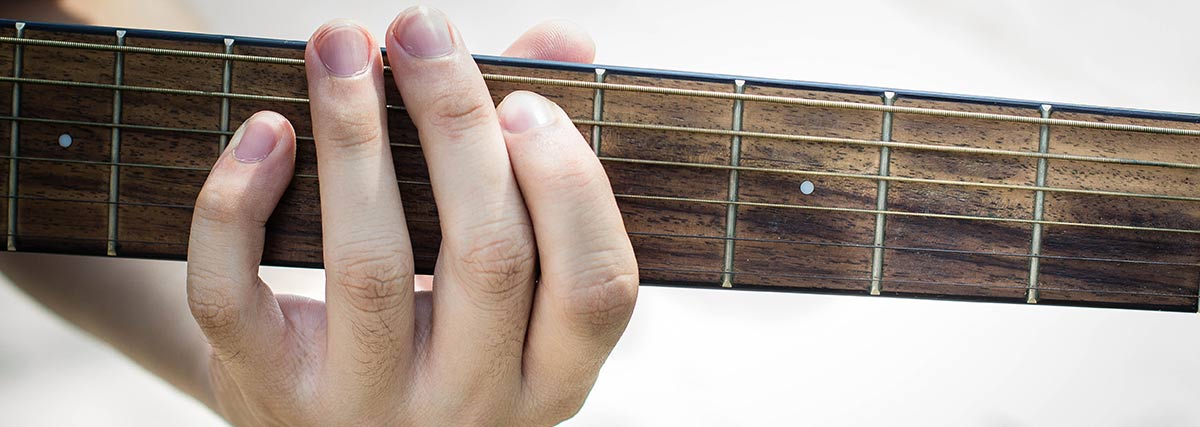
The first detail to examine is the position of your index finger.
Many players place the barre too far from the fret, which makes buzzing much more likely.
For a clear sound, your index finger should sit close to the fret wire — not directly on top of it, but just behind it.
This small movement can make an enormous difference.
The closer your finger is to the fret, the less pressure is required to produce a clean note.
Try this slowly.
Place your index finger across the strings, then move it slightly closer to the fret and listen again.
You may immediately hear the buzz begin to disappear.
Step Two: Use The Side Of The Finger, Not The Soft Flat Part
Another common mistake is trying to press the barre with the completely flat, fleshy part of the index finger.
This part of the finger is soft and uneven.
It often allows some strings to sink into little gaps, especially around the joints.
The result is usually a chord where some notes ring clearly while others buzz or disappear.
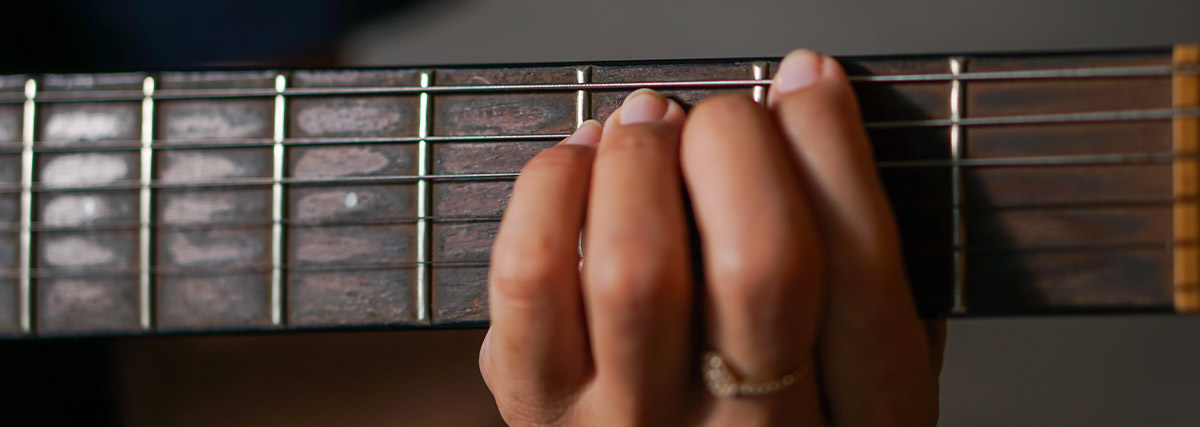
Instead, rotate the index finger very slightly towards its side.
You do not need an extreme angle, but a modest turn helps create a firmer and more even surface.
This is one of the most important discoveries in learning barre chords.
A small rotation can achieve what extra squeezing never could.
Step Three: Do Not Press Every String Equally
This may sound surprising, but a barre chord does not always require equal pressure across all six strings.
In many chord shapes, some notes are already being held down by other fingers.
For example, in an E-shape barre chord, your middle, ring, and little fingers are taking responsibility for several strings.
The index finger does not need to do all the work.
Adult learners often make barre chords harder by trying to clamp every string with maximum force.
This creates fatigue and tension without necessarily improving the sound.
Instead, learn where pressure is actually needed.
If a string is already fretted by another finger, your barre does not need to dominate it.
This makes the whole hand feel lighter and more efficient.

Step Four: Bring The Thumb Into A Better Position
The thumb plays a quiet but vital role in barre chords.
If the thumb is too high over the neck, the fingers may struggle to apply pressure from a useful angle.
If it is too low or too far away, the hand can lose stability.
The best position is usually somewhere behind the neck, roughly opposite the index or middle finger.
The thumb should support the hand rather than crush the neck.
Think of the thumb and fingers as working together, not against each other.
When the thumb is well placed, the index finger can press more efficiently and the remaining fingers can curve more naturally.
If you feel pain or heavy strain in the thumb, pause and reset.
Barre chords should feel demanding at first, but they should not feel harmful.

Step Five: Build The Chord In Stages
One of the most effective ways to fix a buzzing barre chord is to stop practising it as a complete chord for a moment.
Instead, build it in stages.
Start with only the index finger across the strings.
Play each string one at a time and notice which ones buzz.
Adjust the finger position until the notes become clearer.
Then add the remaining fingers of the chord shape.
Again, play each string individually rather than strumming immediately.
This process may feel slower, but it is much faster in the long run.
It tells you exactly where the problem is, instead of leaving you with the vague feeling that “the chord does not work”.
Step Six: Release Unnecessary Tension
Barre chords often expose tension that was already present in a player’s technique.
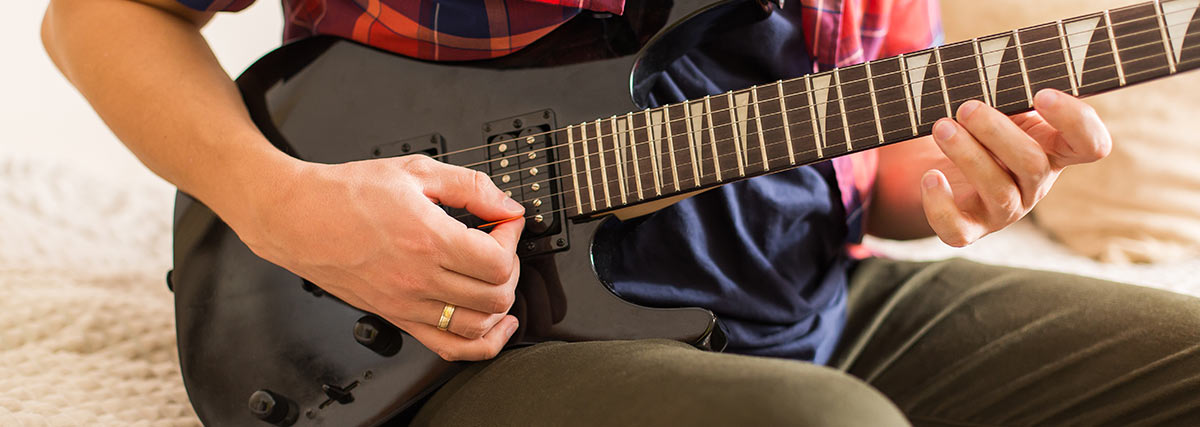
If the wrist is locked, the shoulder is raised, or the arm is stiff, the hand has to work much harder than necessary.
This is especially common among adult learners, who often approach difficult skills with admirable determination but too much physical effort.
Before playing the chord, take a moment to relax the shoulder.
Allow the arm to feel heavy.
Keep the wrist comfortable and avoid forcing it into an extreme bend.
Then place the chord again.
A relaxed hand is not a weak hand.
It is a hand that can move, adjust, and apply pressure where it matters.

Step Seven: Practise Higher Up The Neck First
The F major barre chord at the first fret is famously difficult because the strings are tighter near the nut.
If you are struggling badly, do not begin there.
Move the same shape higher up the neck, perhaps around the fifth or seventh fret.
The strings usually feel easier to press in this area, which allows you to learn the shape without fighting quite so much resistance.
Once the chord sounds clean higher up, move it gradually back towards the first fret.
This approach builds confidence and control.
It also prevents you from associating barre chords with frustration from the very beginning.

Step Eight: Avoid Testing The Chord Too Harshly
Many learners test a barre chord by strumming it loudly and quickly.
Unfortunately, this often makes the problem sound worse and gives very little useful information.
A better method is to play the strings one by one.
Listen carefully. Which string is buzzing? Is it under the index finger?
Is another finger touching it accidentally? Is the finger too far from the fret?
Once each note sounds clear individually, then strum the full chord gently.
Clarity comes before volume.

Why Adult Learners Often Struggle With Barre Chords
Adult learners are often very aware of mistakes.
This can be helpful, but it can also make every buzz feel more frustrating than it needs to be.
Barre chords take time because they combine several skills at once: finger placement, thumb support, wrist angle, pressure, and listening.
You are not just learning a chord; you are teaching the hand a new way to organise itself.
A simple daily exercise can help.
Choose one barre chord shape, start higher up the neck, and play each string separately.
Adjust until the notes sound clear, then add the other fingers and strum gently.
After a few repetitions, release the hand completely.
With five focused minutes a day, many adult learners begin to make real progress without forcing or over-tensing the hand.
Learning Barre Chords With Proper Guidance
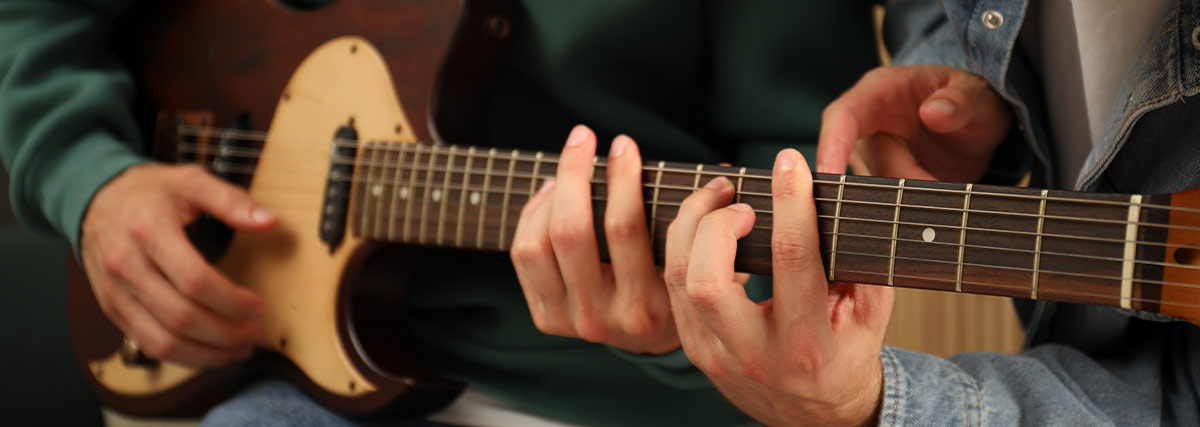
Small physical adjustments can be difficult to notice on your own.
A slight rotation of the finger, a better thumb position, or a softer wrist can make a significant difference to the sound.
At S&C Guitar, we help adult learners approach barre chords as a skill that can be understood and refined, not as a test of strength.
With the right guidance, buzzing problems can often be identified quickly and corrected with much more confidence.
A buzzing barre chord is not a failure.
It is simply a sign that something in the hand position, pressure, or balance needs attention.
When you respond calmly and methodically, the chord gradually becomes clearer, more comfortable, and far more satisfying to play.

RELATED POSTS